
Walk into an Indian kitchen and ask for hung curd. Walk into a supermarket and pick up a tub of Greek yogurt. Put them side by side, and they look almost identical.
- Both are thick.
- Both are creamy.
- Both are tangy.
- And both are often marketed as high-protein dairy foods.
So are they actually the same thing?
Almost — but not completely.
Hung curd and Greek yogurt are made using a very similar process, but the milk, bacterial cultures, texture, economics, and even the way they fit into Indian cooking can be quite different.
And once you understand those differences, it becomes much easier to decide:
- which one to use,
- which one is more economical,
- and how to make thick, creamy hung curd at home that rivals store-bought Greek yogurt.
Quick Takeaway
If you want the short version first:
- Hung curd and Greek yogurt are very similar strained dairy products.
- Both are made by removing whey from fermented milk.
- Greek yogurt is usually made with standardized commercial cultures.
- Hung curd starts with traditional Indian dahi.
- Homemade hung curd is usually much cheaper in India.
- Buffalo milk naturally produces thicker, creamier curd than cow milk.
- Both can fit into a high-protein diet.
What Hung Curd and Greek Yogurt Have in Common
At their core, both foods are made the same way:
A fermented dairy product is strained to remove whey — the watery liquid portion of milk.
As the whey drains out:
- the texture becomes thicker,
- the protein becomes more concentrated,
- and the flavor becomes richer and creamier.
That is why both hung curd and Greek yogurt:
- feel thicker than regular curd,
- contain more protein per spoon,
- and work well in dips, desserts, marinades, and breakfast bowls.
In most recipes, you can substitute one for the other without major changes.
Where They Actually Differ
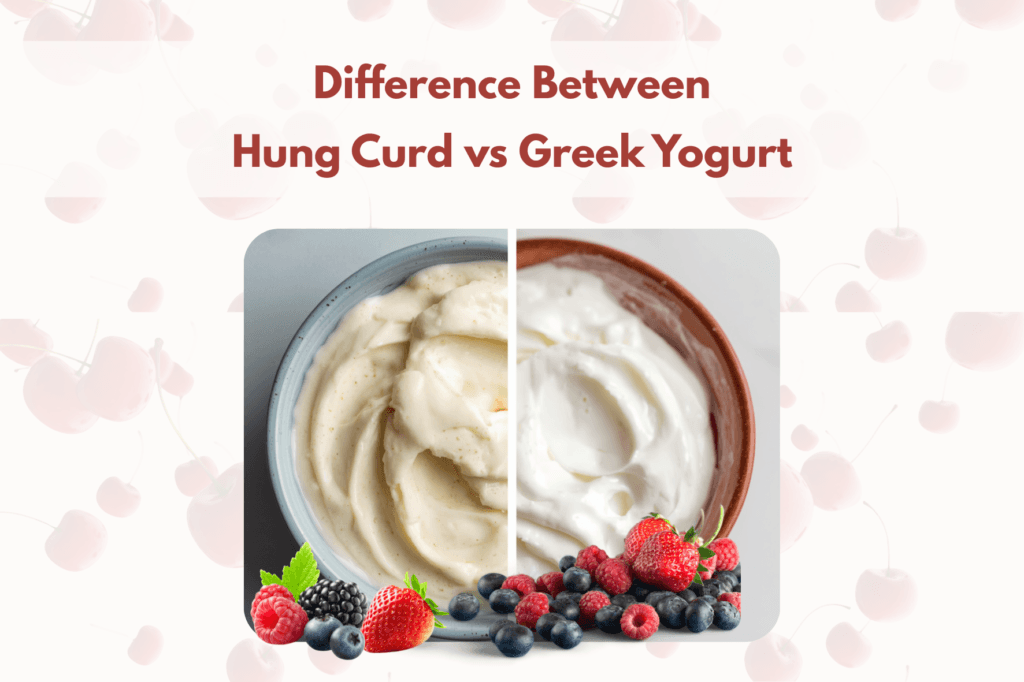
The real differences come down to:
- the milk used,
- the fermentation cultures,
- and the intensity of straining.
1. The Starting Point Is Different
Hung curd begins with Indian dahi.
Traditional dahi is made by fermenting milk using a small portion of a previous batch as the starter culture.
In many Indian homes, this process has been repeated for years, which is why homemade curd often tastes slightly different from one household to another.
The fermentation usually happens at room temperature.
Greek yogurt is typically made using specific commercial bacterial cultures under controlled industrial conditions.
This gives Greek yogurt:
- a smoother texture,
- a milder flavor,
- and greater consistency across batches.
Commercial brands are designed to taste almost exactly the same every time.
2. The Milk Makes a Bigger Difference Than Most People Realize
This is one of the most important differences — especially in India.
Most Western Greek yogurt is made using cow milk.
But many Indian households still make dahi using buffalo milk or full-fat milk, which naturally contains:
- more fat,
- more protein,
- and more casein.
That matters because buffalo milk produces naturally thicker curd even before straining begins.
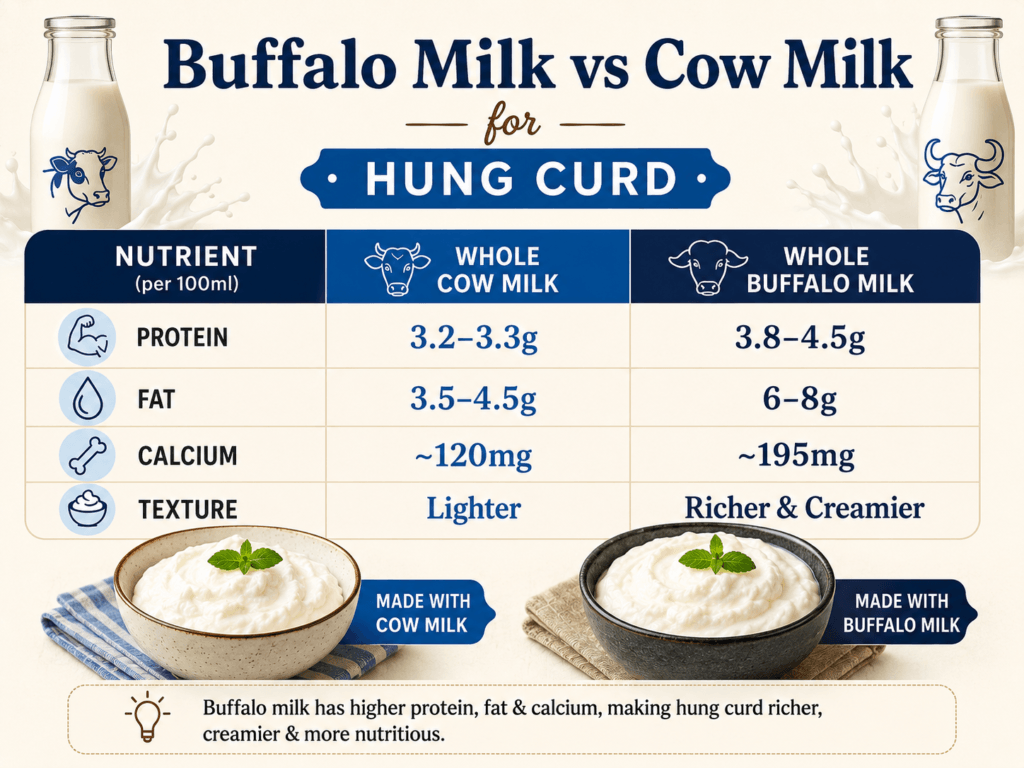
Buffalo Milk vs Cow Milk for Hung Curd
| Nutrient (per 100ml) | Whole Cow Milk | Whole Buffalo Milk |
| Protein | 3.2–3.3g | 3.8–4.5g |
| Fat | 3.5–4.5g | 6–8g |
| Calcium | ~120mg | ~195mg |
| Texture | Lighter | Richer & Creamier |
What This Means Practically
If you make hung curd using full-fat buffalo milk dahi:
- it thickens faster,
- becomes creamier,
- and often tastes richer than many commercial Greek yogurts.
This is one reason homemade hung curd in India can feel surprisingly luxurious despite costing much less.
Nutritional Comparison
The exact nutrition varies based on:
- milk type,
- straining duration,
- and brand.
But in general:
| Buffalo Milk vs Cow Milk for Hung Curd | Plain Dahi | Hung Curd | Greek Yogurt |
| Protein | 3–4g | 8–12g | 9–15g |
| Fat | 4–5g | 5–8g | 4–6g |
| Carbohydrates | 4–5g | 3–5g | 3–5g |
| Texture | Soft | Thick | Thick |
| Whey Content | High | Reduced | Reduced |
The key point is this:
Straining removes whey and concentrates the solids.
That naturally increases protein density compared to plain curd.
Why Fitness Enthusiasts Are Switching to Hung Curd
One major reason hung curd has become popular again is protein awareness.
Many Indian households are now actively trying to:
- increase protein intake,
- reduce processed foods,
- and find affordable alternatives to expensive health products.
Hung curd fits surprisingly well into that shift.
It works as:
- a high-protein breakfast base,
- a sandwich spread,
- a smoothie ingredient,
- a dip,
- or a post-workout snack.
And unlike imported Greek yogurt tubs, homemade hung curd is affordable enough for regular use.
The “Protein Per Rupee” Advantage
This is where homemade hung curd becomes extremely interesting for Indian consumers.
A tub of commercial Greek yogurt in India is often expensive relative to regular curd.
Homemade hung curd, however, can deliver very similar nutritional benefits using:
- regular milk,
- homemade dahi,
- and a proper straining method.
For students, gym-goers, families, and budget-conscious households, this matters a lot.

You are essentially converting ordinary curd into a concentrated, protein-rich food at a much lower cost.
In the Kitchen — Which One Should You Use?
In practice, the two products are interchangeable most of the time.
But some recipes naturally suit one better than the other.
Hung Curd Works Especially Well For
- Shrikhand
- Tandoori marinades
- Paneer tikka
- Raita
- Dahi kebabs
- Indian-style dips
- Sandwich spreads
- High-protein snack bowls
Hung curd usually has a slightly deeper and tangier flavor that works beautifully in Indian recipes.
Greek Yogurt Works Especially Well For
- Tzatziki
- Smoothie bowls
- Cheesecakes
- Mediterranean dips
- Western breakfast parfaits
Greek yogurt is usually smoother and milder.
Don’t Throw Away the Whey

When you strain curd, the yellowish liquid that collects below is whey.
Most people throw it away.
That is a missed opportunity.
Whey still contains:
- minerals,
- small amounts of protein,
- and natural milk nutrients.
Many Indian households now reuse whey for:
- kneading roti dough,
- soups,
- smoothies,
- dosa batter,
- gravies,
- and rice dishes.
It also helps reduce kitchen waste.
The Biggest Difference Is Actually the Straining Method
No matter which one you make — hung curd or Greek yogurt — the final texture depends heavily on how you strain it.
Traditional muslin cloth works, but it also creates common problems:
- dripping,
- uneven straining,
- sourness from room-temperature hanging,
- messy cleanup,
- and curd sticking to the cloth.
That is why many people now prefer dedicated yogurt strainers.
A refrigerator-friendly strainer allows:
- cleaner whey separation,
- better texture consistency,
- less mess,
- and easier everyday use.
The ZIVANCA Greek Yogurt Strainer is designed specifically for this process, using a fine mesh basket and outer container system that strains curd cleanly inside the refrigerator.

The process is simple:
- Pour in curd and close the lid
- Refrigerate
- Scoop out thick hung curd a few hours later
No hanging cloth required.
From Curd to Creamy Yogurt in 3 Steps

Fill
Add fresh curd or yogurt

Strain
Refrigerate overnight, adjust for thickness

Enjoy
Scoop, serve & savor
What’s Inside the Box

Outer container, stainless steel strainer, airtight lid, and a free recipe eBook.

OUTER CONTAINER – 1.1 L

STRAINER – RUST RESISTANT

TRANSPARENT AIRTIGHT LID

Free Recipe e-Book Access
Free Recipes + Exclusive Discount 🎁
Every strainer comes with special rewards!
Strain & Savor
25+ Vegetarian Recipes with Greek Yogurt & Hung Curd

Discount
Exclusive Discount Code for Your Next Purchase
Trusted Quality for Indian Kitchens

We bring you tools that make healthy living simple, safe, and practical.
Frequently Asked Questions
They are very similar but not identical. Both are strained dairy products, but hung curd starts with Indian dahi while Greek yogurt uses standardized yogurt cultures.
Commercial Greek yogurt often contains slightly more protein because industrial straining removes whey more aggressively. However, homemade hung curd still provides significantly more protein than regular curd.
Yes. In most recipes, the substitution works perfectly.
Hung curd can be a useful high-protein food in a balanced diet because protein helps improve fullness and satiety. Portion size still matters.
If curd strains at room temperature for too long, fermentation continues and acidity increases. Refrigerator straining usually gives a milder flavor.
No. Hung curd is lower in lactose than milk because some lactose leaves with the whey, but it is not completely lactose-free.
Yes. Many people make Greek-style yogurt at home simply by straining thick dahi until it reaches the desired consistency.
The Bottom Line
Hung curd and Greek yogurt are closely related foods made using the same basic principle: straining fermented dairy to remove whey.
But the Indian version has one major advantage:
it is far more economical and naturally suited to Indian cooking.
And when made using full-fat buffalo milk dahi, homemade hung curd can be incredibly rich, creamy, and satisfying — easily comparable to many commercial Greek yogurt products.
The real secret is not just the milk.
It is the straining method.
A clean, refrigerator-friendly yogurt strainer makes the entire process:
- easier,
- less messy,
- and far more consistent.
If you regularly make hung curd, shrikhand, high-protein snack bowls, or homemade Greek yogurt, a dedicated strainer can save time while improving results.
Shop the ZIVANCA Greek Yogurt Strainer on Amazon India and make thick, creamy hung curd at home without the mess of muslin cloth.